
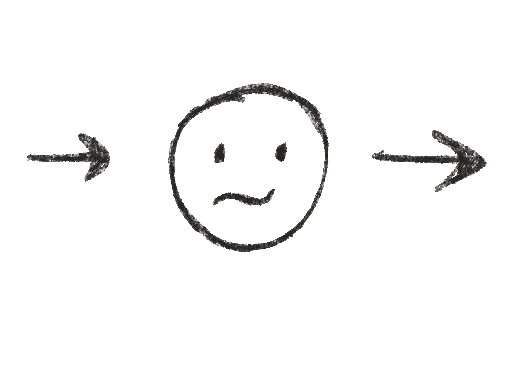
I’ve always been afraid of making irreversible choices. The main example I often use is the posting of a letter in a letterbox. The moment I need to let go of the letter I always dread things like “ Did I write the correct postal code?” or “ Is this the right letterbox, what if it doesn’t get there?”.
Recently, my wife and I have made another irreversible choice: becoming parents. This made me think even more about the process of making such big decisions, because it turns out that at least for me, keeping an objective overview of how that process went turned out to be quite difficult. This choice also turned out to be even more permanent than I thought. Biologically for women, pregnancy causes permanent physiological changes (heart size, brain structure, immune system) (source)
For me, and I think for us, the (perceived) fear about being locked into a certain path or consequence is the main difficulty in these kinds of situations, and especially the bigger choices in life seem at first glance black or white (moving house, kids or no kids) but on closer inspection (or long periods of emotional stress and (over)thinking) even those choices are greyer than you would’ve thought before hand.
For example for a true black and white choice: if you do choose to go for kids, you’ll most probably grieve at a certain point about a loss of flexibility and freedom. On the other hand if you choose to not have kids there will be a large period of life (for women a shorter and more intense period probably than men) where “it’s still a possibility” until it becomes irreversible. And even if you do make the choice to never have kids, you are likely to at least once mourn about that option being out of your life. This is already a bit “greyer” than true black and white.
In my line of work I see a lot of young people in a very dynamic stage of their life. They face a lot of challenges and seemingly black and white choices in a lot of different life dimensions. “Should I break up with him?”, “Should I change my masters?”, “Should I shut out my parents?”. If the student is particularly unlucky these questions arise at the same time. Often during therapy we try to “grey out” these choices. We gather more info and untangle emotion from rationality and facts. Do you need to break up or do you need to have a difficult conversation about something else first? Why do you want to change the masters, are there additional or replaceable courses to fill in the gap you feel? Do you need to shut out your parents or are you practicing with boundaries? Will you be ok if the boundary really is “never again?”
What I find interesting in observing my own dilemma and the dilemmas of the students is that there seems to be three distinct “stages” around making a choice.
The “before” state
The “during” state
The “after” state

The before state
We all know how this state feels. You are gathering information while you are faced with a difficult choice. It can feel misty, murky and muddy to be in this stage. Especially since making a choice is a very subjective state to be in. Your own emotions on the subject play a very big role, but emotions can be fickle and change as well!
The during state
This is an interesting state in my opinion. Just with the past, present and future, the present and the “now” is constantly slipping away from us in a rapid (irreversible!) pace. The moment of choice itself can feel like a very short period as well sometimes, but is probably more spread out about a certain period of time. This seems especially true for larger life choices where time, talking to others (removing a bit of subjectivity in the process) and multiple emotions (and nights of sleep) can bring more clarity as a choice approaches
The after state
This state can be a tricky one in my opinion. How often have I heard the phrase “ of course you chose that, it was obvious the entire time!” when I told other people about the fact that we were expecting a child. This is a false conclusion in my opinion, since the act of making that choice gave us extra information about that choice. The choice became more gray as well, since we became more scared of the future, but also felt a loss of pressure on our shoulders as we at least knew we were going in a certain path to the future.
Also at work I see students making this “mistake”. After a sense of relief (or fear if it turned out to be the wrong choice) the students gaslight themselves by saying “I should’ve seen it earlier, I should have known”, whereas the act of choice itself gave the student the extra information to continue on in the process of choosing. The mind also makes you like your choice more after you make it (source)
I personally think that the before and during state of decision making are secretly the same state, where the before state is just future you looking back on past you not having made the choice yet, since the choosing itself is also still a bit of information gathering. Humans like to think in black and white, whereas reality is a lot grayer and more fluid and interchangeable then we would like it to be. If we can accept that last fact and internalize it a bit more, it might make hard decisions a bit less daunting since you are allowed to take a bit of time on the choice. Even when the choice needs to be made quickly. Most choices are not as black and white as we think and definitely not as irreversible.
Research also shows that irreversible decision-making actually leads to higher post-choice satisfaction than reversible choices. Once you’ve made one your mind tends to focus on the positives of that choice. (source)
The main irreversible choices i’ve found so far are: Death, Biological aging of cells (not really a conscious one there, in a way you have no choice), Learning new skills (neural rewiring) (source), Having children, Severe physical trauma or Organ loss, Psychological trauma (early life especially).
The other choices in life seem irreversible, but are often only practically irreversible, or to put it another way: Just too hard at the time to reverse. Examples of these are: divorce, emigration or quitting a job.
To end, I’d like to elevate the irreversibility of learning new things or skills. It’s not completely irreversible of course, it can happen through mental sickness (dementia for example, but even then sometimes skills and knowledge can resurface in the right environments). But my interest is again in the past and future state of knowledge. There is a time you did not know something, and then “suddenly” you do. It is my strong suspicion that this is also too much of a black and white view (of mine). Learning and “getting” things is a gradual and gray process that I’ve seen happen too often in my old work of after school teaching. Especially bigger complex subjects take time, effort, emotion and rationality to fully grasp, just as making choices. Weirdly enough most people quickly dismiss this process after they’ve “gotten it”. As if it’s black and white again. I think humans should be more emphatic to the gray gradual process of learning, not knowing (yet) and (slower) decision making.
Let me know if you’ve achieved this.


Leave a Reply